
Login

We are experiencing technical difficulties. Your form submission has not been successful. Please accept our apologies and try again later. Details: [details]

Register

We are experiencing technical difficulties. Your form submission has not been successful. Please accept our apologies and try again later. Details: [details]

Thank you for registering

An email to complete your account has been sent to

Return to the website

get direct access

Fill in your details below and get direct access to view content

Text error notification

Text error notification

Checkbox error notification

Checkbox error notification

We are experiencing technical difficulties. Your form submission has not been successful. Please accept our apologies and try again later. Details: [details]

Thank you for your interest

You now have access to The next operating system for manufacturing in Europe: From control to coexistence

A confirmation email has been sent to

Continue to page

Please or get direct access to download this document

Industry 4.0
Operational Excellence

The next operating system for manufacturing in Europe: From control to coexistence

Published on 08 January 2026 in Industry 4.0

For more than two centuries, the story of industrial progress has been written in the language of control. Control over machines. Control over processes. Control over resources and, at times, even over people. This was the logic that powered mass production and global supply chains.

But today, its limits are becoming clear.

The global manufacturing industry now operates in a world defined by climate volatility, energy insecurity, demographic contraction, and geopolitical fragmentation. In Europe, where energy costs are high, labour is scarce, and global competition intense, success will depend not on scale or speed but on our ability to combine technology, human values, and collaboration into a more resilient model of progress. 

At the Osaka Expo 2025, Ikuo Tateishi, President of the Human Renaissance Institute and grandson of OMRON’s founder, delivered a clear message: the age of maximization and control is ending.- and a new age of coexistence is beginning.

The old industrial operating system, built for predictability and optimization, needs to be replaced with adaptive, co-creative networks connecting people, machines, and the planet.

Europe’s industrial future depends on coexistence: From optimization to autonomy and beyond

OMRON’s founder, Kazuma Tateishi, foresaw this transformation over 50 years ago in his SINIC Theory which describes how science, technology, and society evolve in continuous feedback loops. The SINIC Theory foresaw a societal transition from:

  • an Optimization Society (around early 2000s) centered on efficiency and productivity; to
  • an Autonomous Society (2025–2050) where systems self-organize, communicate, and learn without centralized control; to
  • a Natural Society, where humanity, technology, and nature evolve in harmony, forming a regenerative and balanced ecosystem.
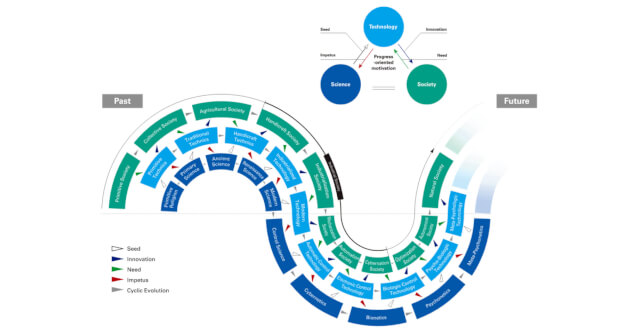
This progression, once theoretical, is now unfolding in real time across factories around the world. Machines that sense, decide, and adapt in real time; production systems that respond dynamically to variation; and factories that share operational data to improve energy and material efficiency.

To be clear: Autonomy is not about removing people. It is about amplifying their intent. Moving from control to coexistence means enabling technology that listens, collaborates, and creates space for human creativity and purpose.

The new blueprint: Six shifts toward a coexistence economy

The transition toward coexistence requires rethinking how manufacturing systems are designed, connected, and measured. It is not based on a single innovation but an integrated transformation across technology, culture, and collaboration. To thrive in this new era, Europe must shift from control to coexistence across six interconnected dimensions:

1. From isolated efficiency to systemic resilience
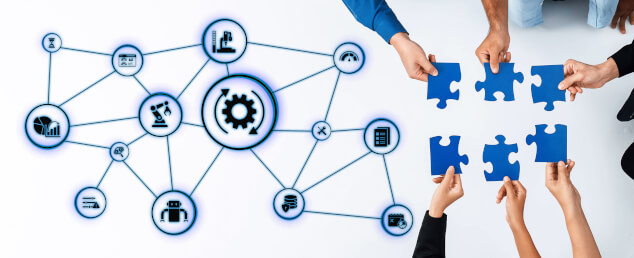
Efficiency remains necessary, but no longer sufficient. European manufacturers now need systems that can move from control logic to adaptive feedback and systems that adjust continuously rather than reactively.

Practically, this means for example using automation and AI to stabilize operations and to enhance resilience, predicting variability and maintaining productivity in unstable conditions.

For instance, smart machine vision and predictive maintenance technologies help manufacturers balance throughput with energy use, reducing waste and unplanned downtime simultaneously.

This is resilience as competitive advantage, and Europe is uniquely positioned to lead it. For decades, the region has championed a balanced industrial ecosystem where humanity, nature, and technology coexist. The next generation of manufacturing will build directly on that foundation.

2. Co-creation over competition

Co-creation means working across industries, governments, and research institutions to solve shared challenges. In Europe, there is already a strong foundation for collaboration: innovation clusters, research alliances, and sustainability programmes. 

The next step is to make these networks more open and agile, accelerating how ideas turn into real-world impact. No single company or nation can achieve decarbonisation or digitalisation alone.

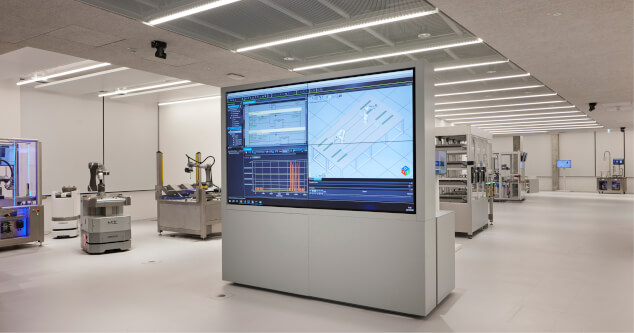
Competitive advantage in manufacturing will increasingly come from shared innovation. For example, at OMRON’s Automation Centers across the world, customers can run proof-of-concept tests using robotics, sensing, and AI control systems under realistic conditions. We collaborate with machine builders and system integrators to bring these solutions to the factory floor.
3. From linear production to circular design

The transition to the Natural Society envisions a balance between industry and the environment. In Europe—already the world’s regulatory leader—circularity is becoming both an environmental and economic imperative. In manufacturing terms, this means moving beyond take–make–dispose models toward circular production, where systems are designed to regenerate materials and energy.

Automation needs to supports:
  • zero-waste production,
  • material recovery,
  • and energy regeneration
We apply this principle both internally and with our customers. Our own factories are implementing energy visualization and reduction systems, while automation solutions—like power-optimized drives and compact motion controllers—help customers achieve measurable CO₂ reductions on production lines.

4. From central control to distributed intelligence

The next stage of manufacturing will rely on autonomous, connected modules that think locally and learn globally. This decentralized architecture increases agility and resilience, enabling continuous operation even when parts of the system are disrupted.

We are developing a global data platform that links data generated by our devices and services with partners’ data, creating the foundation for new solutions that combine hardware, software, and services. This platform is helping drive a new era of distributed intelligence. It will link edge devices, control systems, and cloud analytics so that factories can learn continuously and adapt in real time. Across Europe, manufacturers piloting IT/OT integration with partners such as Cognizant, are using real-time sensor data and predictive models to optimize production performance and improve flexibility across their operations.

5. From efficiency to transparency

As automation becomes more autonomous, trust replaces control as the foundation of system stability. Technology governance ensures that autonomy is accountable, explainable, and ethical.

OMRON has embedded these principles into R&D through a framework that requires each innovation to be assessed for safety, transparency, and social impact. In line with our AI Governance Policy, we integrate explainability and data traceability principles into our robotics and automation systems to ensure human operators can understand and oversee automated decisions.

In the broader sense, transparency is becoming a competitive differentiator: manufacturers that can prove how their systems make decisions will build stronger trust among customers, regulators, and society. That trust is especially critical when decision-making is shared between humans and machines.

6. From predictability to adaptability

Coexistence demands organizational adaptability and systems that can respond to change without losing integrity. The strongest manufacturing systems will be those that can adapt:
  • switching between product variants quickly,
  • empowering teams to optimize in real time,
  • redesigning workflows without months of engineering.

This combination of technological agility and organizational autonomy mirrors the balance envisioned in SINIC’s next stage, the Natural Society, where growth is not driven by scale, but by harmony and responsiveness.

A realistic path forward

Moving from control to coexistence will not be easy. The political and economic climate in many regions favours protectionism over collaboration. Concerns about job displacement, data security, and ethical AI are legitimate and must be addressed transparently.

OMRON has taken a landmark step by making the SINIC Theory open source, inviting innovators worldwide to co-create the transition between the Autonomous and Natural Society.

The message is clear: the shift from control to coexistence will only succeed if it is collaborative. Industry, technology, and society must evolve together, guided by shared purpose and mutual benefit.

Every industrial revolution has been an upgrade of our collective operating system. The next one is not about replacing people with machines. It is about reconnecting technology to purpose. If control was the language of the 20th century, coexistence will define the 21st. The next wave of industrial progress will be built on a more sustainable, human, and resilient way of creating value, and Europe has the potential to lead this progress globally.
Contact us for more information

Contact Omron specialists

Do you have any questions or would you like personal advice? Feel free to contact one of our specialists.
  • Omron Europe

    Omron Europe